

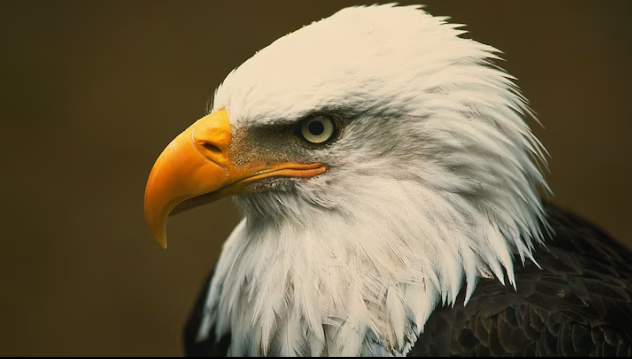
A bald eagle’s white head may make it look bald. But actually the name comes from an old English word, “balde,” meaning white. These graceful birds have been the national symbol of the United States since 1782.
Bald eagles were on the brink of extinction because of hunting and pollution. But laws created almost 40 years ago have helped protect them, and they’ve made a comeback.
Female bald eagles are a bit bigger than males. Their bodies can be three feet (one meter) long, and their wingspan can be eight feet (2.4 meters) across. That’s about the distance from the floor to the ceiling!
Eagle nests are called aeries (AIR-ees). Bald eagles build their nests at the very top of tall trees so the eggs will be safe. Some parents come back year after year to the same nest, adding more sticks, twigs, and grass each time.
Scientific Classification
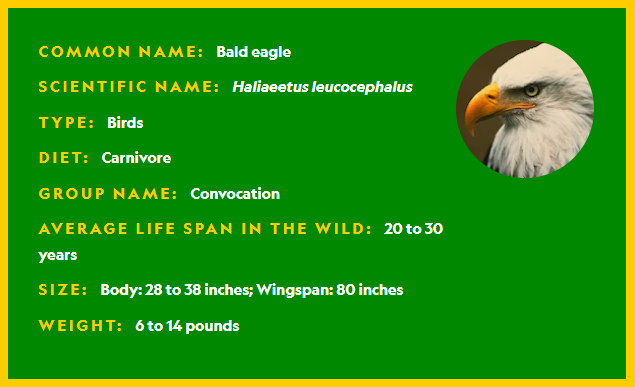
- Common name: Bald Eagle
- Scientific name: Haliaeetus leucocephalus
- Kingdom: Animalia
- Phylum: Chordata
- Class: Aves
- Order: Accipitriformes
- Family: Accipitridae
- Genus: Haliaeetus
- Species: Haliaeetus leucocephalus
The genus Haliaeetus contains the sea eagles, a group of large eagles generally associated with water.
The scientific name Haliaeetus leucocephalus can be interpreted as referring to a sea eagle with a white head.
Appearance
The Bald Eagle is a large, powerful raptor with distinctive adult plumage.
An adult has:
- A white head
- A white tail
- Dark brown body feathers
- Broad wings
- A large yellow bill
- Yellow eyes
- Yellow feet
- Powerful black talons
The contrast between the white head and dark brown body makes adult Bald Eagles particularly easy to identify.
Adult Plumage
Adult Bald Eagles generally develop their characteristic white head and tail after several years of growth.
Before reaching adulthood, young Bald Eagles look very different.
Juveniles are mostly dark brown and may have:
- Brown heads
- Brown tails
- White mottling
- Dark bills
- Darker eyes
Because immature Bald Eagles lack the distinctive white head, they can sometimes be mistaken for other large birds of prey.
Size
Bald Eagles are among the largest birds of prey in North America.
Typical measurements include:
- Length: approximately 28–40 inches (71–102 cm)
- Wingspan: approximately 71–91 inches (180–230 cm)
- Weight: roughly 6.5–14 pounds (3–6.3 kg)
Females are generally larger and heavier than males.
This difference between males and females is known as sexual dimorphism.
Wings
The Bald Eagle has enormous broad wings designed for powerful flight and soaring.
Its wings allow it to:
- Glide over lakes and rivers
- Soar on rising air currents
- Search for prey
- Travel long distances
- Carry food
- Defend its territory
Bald Eagles can often be seen circling high above water or open landscapes while searching for opportunities below.

Babies, called eaglets, are born light gray then turn brown. When they are four to five years old, they develop their normal white heads and tails. In the wild, they can live to be 35 years old or more.
Bald eagles can soar over 10,000 feet (3,048 meters) high, and their great eyesight lets them see fish up to a mile (1.6 kilometers) away. When they attack, they drop down at up to 100 miles (161 kilometers) an hour! Then they glide just above the water, snag a fish with their feet, and fly off to eat it.
Hunting Strategy
Bald Eagles do not always catch their own food.
They are opportunistic hunters and scavengers.
They may:
- Catch live fish
- Capture waterfowl
- Hunt mammals
- Eat dead animals
- Take advantage of fish kills
- Steal food from other birds
This flexible strategy allows them to survive in a wide range of environments.
Food Stealing
Bald Eagles are known for kleptoparasitism, which means obtaining food by taking it from another animal.
They may harass other birds, including:
- Ospreys
- Other eagles
- Hawks
- Gulls
The eagle may chase another bird until the smaller bird drops its food, allowing the Bald Eagle to grab it.
Osprey and Bald Eagle
Bald Eagles and Ospreys sometimes compete for fish.
Ospreys are specialized fish hunters, while Bald Eagles have a broader diet.
A Bald Eagle may steal a fish from an Osprey, especially when the eagle can use its greater size and strength to intimidate the smaller bird.
Scavenging
Bald Eagles are also important scavengers.
They may consume:
- Dead fish
- Dead waterfowl
- Mammal carcasses
- Animal remains
- Fish-processing waste
Scavenging is an efficient way for eagles to obtain food without spending energy chasing live prey.
Social Behavior
Bald Eagles are not always solitary.
They may gather in groups when food is abundant.
Large concentrations can occur around:
- Fish spawning areas
- Rivers
- Lakes
- Reservoirs
- Fishing areas
- Animal carcasses
Although they may tolerate other eagles when food is plentiful, they can become highly territorial around nests.
Territorial Behavior
Breeding Bald Eagles defend territories around their nests.
They may defend these areas against:
- Other Bald Eagles
- Ravens
- Hawks
- Other large birds
- Potential predators
Territorial displays can include:
- Calling
- Flying toward intruders
- Chasing
- Diving
- Circling
- Talon displays
Bald Eagle Calls
The Bald Eagle has a series of high-pitched whistles, chirps, and squeals.
Interestingly, the famous dramatic eagle scream often heard in movies and television is frequently not a Bald Eagle call.
Films and television programs have often used the call of a Red-tailed Hawk over footage of a Bald Eagle because the hawk’s call sounds much more dramatic.
The real Bald Eagle’s voice is generally higher-pitched and less powerful-sounding than the stereotypical movie eagle scream.
