

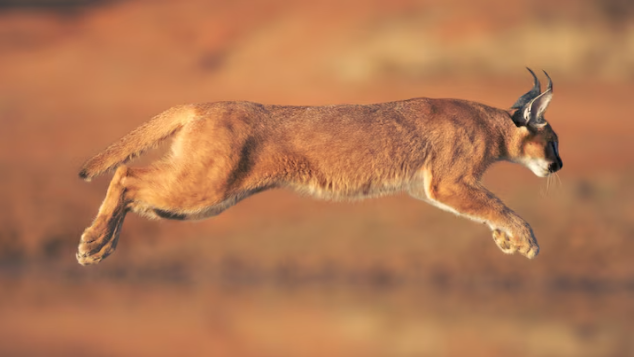
Caracals live on rocky hills or grasslands in the Middle East, Africa, and south Asia. The animal is one of more than 30 species of small wild cats.

A caracal crouches in the tall grass, eyeing a bird perched on a nearby shrub. Suddenly the wild cat bursts from her hiding spot and bolts toward the fowl. As the bird takes off, so does the caracal. She leaps up six feet and swats her prey with her paw, causing it to fall to the ground. Then the cat scoops up the bird in her mouth. It’s dinnertime.
Introduction
The caracal (Caracal caracal) is a medium-sized wild cat famous for its long black ear tufts, powerful athletic body, and remarkable ability to leap high into the air. Sometimes called the desert lynx, the caracal is not actually a true lynx. It belongs to its own genus, Caracal, within the cat family Felidae.
Caracals are highly adaptable predators. They live across large parts of Africa, the Middle East, Central Asia, and South Asia, occupying habitats ranging from dry deserts and semi-deserts to savannas, grasslands, scrublands, mountains, and woodland.
The caracal is particularly famous for hunting birds. Using its powerful hind legs, it can leap several feet into the air and knock flying birds down with its front paws. This spectacular hunting technique is one of the most distinctive behaviors in the cat family.
Although caracals are relatively small compared with lions and leopards, they are powerful, agile, intelligent, and extremely efficient hunters.
Quick Facts About Caracals
- Common name: Caracal
- Scientific name: Caracal caracal
- Family: Felidae
- Order: Carnivora
- Class: Mammalia
- Genus: Caracal
- Diet: Carnivore
- Average lifespan in the wild: Approximately 10–12 years, with variation depending on conditions
- Potential lifespan in captivity: Often longer than in the wild
- Adult weight: Approximately 8–20 kg (18–44 lb), with males generally larger
- Body length: Approximately 60–100 cm (24–39 in), excluding the tail
- Tail length: Approximately 18–35 cm (7–14 in)
- Shoulder height: Approximately 40–50 cm (16–20 in)
- Activity: Primarily nocturnal or crepuscular, depending on location
- Habitat: Savannas, grasslands, scrublands, deserts, semi-deserts, forests, and mountains
- Geographic range: Africa, the Middle East, Central Asia, and parts of South Asia
- Conservation status: Least Concern
- Main prey: Rodents, hares, birds, small antelope, reptiles, and other small to medium-sized animals
- Most famous feature: Long black ear tufts
- Special ability: Powerful vertical leaps for catching birds
What Does a Caracal Look Like?
Caracals have a sleek, muscular body covered in relatively short fur.
Their coat is usually:
- Reddish-brown
- Tawny
- Golden-brown
- Grayish-brown in some populations
The underside of the body is generally lighter, often cream or pale white.
Unlike many other wild cats, adult caracals usually have few or no obvious spots or stripes on their bodies.
Their plain coat provides excellent camouflage in dry grasslands, rocky landscapes, scrub, and desert environments.
SOLO CAT
Most caracals grow about three feet long and can weigh over 40 pounds. The feline is usually most active after sunset. And this cat likes its me-time—adults spend much of their days alone, hunting for birds, rodents, rabbits, and gazelles.

National Geographic Maps
HUNTING AND HUGGING
The body of a caracal is built for sneak attacks. Caracals are superfast, and with footpads cushioned by stiff fur they make practically no noise as they sprint toward targets. The animals’ strong hind legs allow them to jump six feet in the air—the height of a tall adult human. Tufts of hair on the tips of a caracal’s ears may enhance their hearing, making it easier for the cat to listen for prey.
These hunters have a softer side too. Mom caracals (which usually have three babies in each litter) cuddle with their young. And the babies cuddle each other too. See, even ninjas need to snuggle sometimes.
Caracal Body
The caracal has a compact but muscular body.
Its body is designed for:
- Jumping
- Sprinting
- Climbing
- Pouncing
- Capturing prey
- Moving efficiently across difficult terrain
The hind legs are particularly powerful.
This strength allows the caracal to make explosive vertical leaps when hunting birds.
Caracal Legs and Paws
Caracals have long, strong legs and relatively large paws.
Their paws help them:
- Move quietly
- Maintain balance
- Grip prey
- Run across uneven terrain
- Jump
- Climb
Like other cats, caracals have retractable claws.
The claws remain sharp because they can be protected when not being used.
Caracal Tail
The caracal has a relatively short tail compared with many other wild cats.
The tail helps with:
- Balance
- Direction changes
- Movement during hunting
- Communication
Its shorter tail gives the caracal a somewhat compact appearance.
How Big Is a Caracal?
Caracals are medium-sized wild cats.
Adult males are generally larger than females.
Typical adult caracals weigh approximately:
8–20 kilograms (18–44 pounds).
Body length is commonly around:
60–100 centimeters (24–39 inches), excluding the tail.
The tail may measure approximately:
18–35 centimeters (7–14 inches).
Shoulder height is generally around:
40–50 centimeters (16–20 inches).
Size varies between individuals and geographic populations.
Final Summary
The caracal (Caracal caracal) is one of the most fascinating medium-sized wild cats in the world. Famous for its long black ear tufts, reddish coat, powerful legs, short tail, and extraordinary jumping ability, the caracal is a highly specialized predator.
Its remarkable adaptability allows it to survive in environments ranging from African savannas and grasslands to deserts, scrublands, mountains, and parts of Asia.
Caracals are particularly impressive hunters of birds. Their powerful hind legs allow them to launch vertically into the air and strike birds with their front paws. They also hunt rodents, hares, reptiles, and a variety of other animals using stealth, patience, and sudden bursts of speed.
Although caracals are generally solitary and secretive, they play an important role in ecosystems by controlling populations of smaller animals. They are also an important indicator of healthy natural landscapes.
The future of caracals depends on protecting suitable habitat, maintaining healthy prey populations, reducing human-wildlife conflict, protecting wildlife corridors, and promoting coexistence between people and wild predators.
The caracal’s combination of beauty, agility, intelligence, adaptability, and extraordinary hunting ability makes it one of the most remarkable wild cats of Africa and Asia.
