

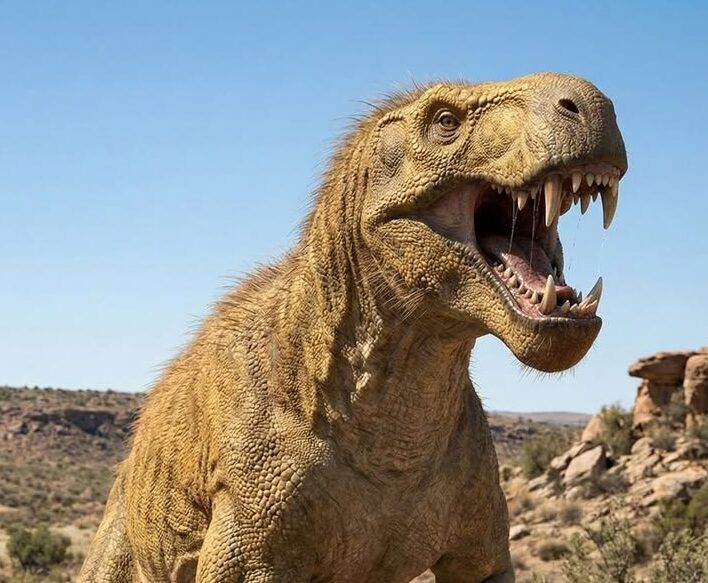
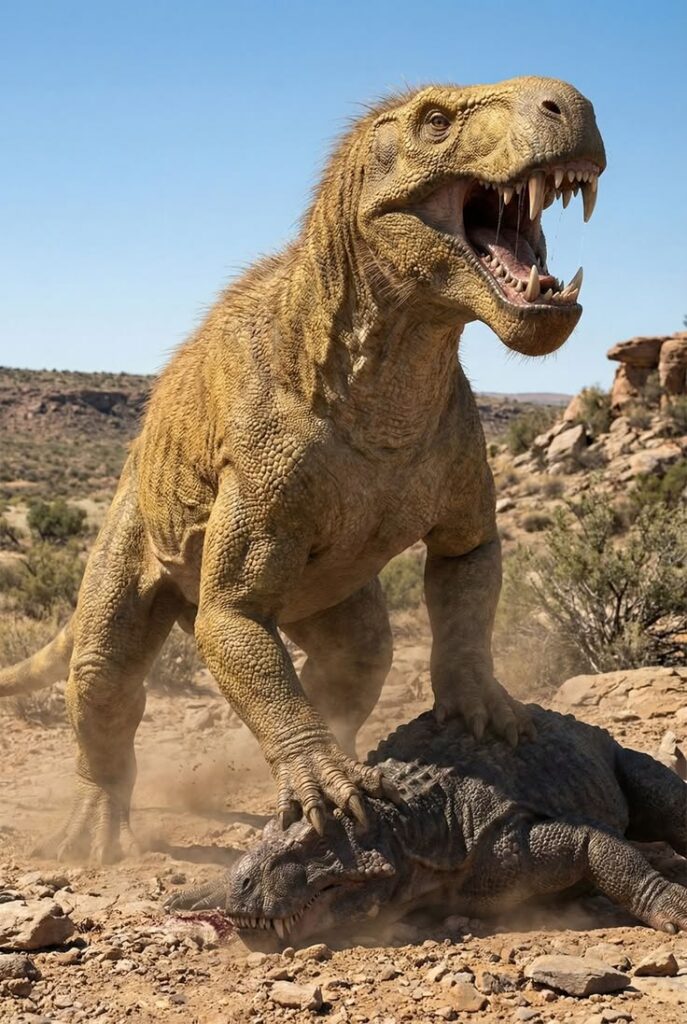
Dinogorgon
🦖 Tyrannosaurus rex
Scientific Name: Tyrannosaurus rex
Meaning: “King of the Tyrant Lizards”
Period: Late Cretaceous
Lived: Approximately 68–66 million years ago
Location: Western North America
Diet: Carnivorous
Type: Large theropod dinosaur
Tyrannosaurus rex was a gigantic two-legged predator that lived near the end of the Cretaceous Period. Fossils have been discovered across parts of what is now the western United States, including Montana and Wyoming. Its enormous skull, powerful jaws, and large serrated teeth made it one of the most formidable terrestrial predators known from the fossil record.
📏 Size and Appearance
Adult T. rex could reach around 12 meters (39 feet) in length, with some exceptionally large individuals estimated at more than that. The Smithsonian’s “Nation’s T. rex,” for example, measured about 11.6 meters (38 feet) and was estimated to weigh roughly 4–5 tons.
It had a huge head, a thick muscular body, powerful hind legs, and a long tail that helped balance its body. Its arms were surprisingly short but were strongly muscled and ended in two clawed fingers. Scientists still debate the precise functions of those small arms.
🦷 Powerful Bite
The skull of T. rex was built for eating meat. Its large, robust teeth were adapted for gripping and tearing flesh, while its powerful jaw muscles allowed it to deliver tremendous forces.
It was probably capable of both actively hunting prey and scavenging carcasses. Scientists believe its excellent senses, including a strong sense of smell and forward-facing eyes that may have provided good depth perception, helped make it an effective predator.
🏃 Movement
Despite its enormous size, T. rex was not necessarily a slow animal. Computer models suggest it could walk at speeds of up to approximately 15 mph (24 km/h). Whether adult T. rex could safely run at higher speeds remains debated.
🪶 Did T. rex Have Feathers?
This is an important detail if you’re using your image on a scientific website.
There is no direct evidence that adult T. rex was covered in feathers. Fossilized skin from Tyrannosaurus and close relatives provides evidence of scaly skin. Some of its more distant or smaller relatives had feathers, so scientists cannot completely rule out limited feather-like structures in areas where skin has not been preserved.
Therefore, the hair-like covering shown in your image should be described as an artistic interpretation, rather than a confirmed feature of T. rex.
🌎 Habitat
T. rex lived in a much warmer world than today. Western North America during the Late Cretaceous contained river systems, floodplains, forests, and abundant vegetation. These environments supported many different dinosaurs and other animals.
📋 Quick Facts for Your Website
| Feature | Details |
|---|---|
| Animal | Tyrannosaurus rex |
| Scientific name | Tyrannosaurus rex |
| Meaning | King of the Tyrant Lizards |
| Era | Late Cretaceous |
| Age | About 68–66 million years ago |
| Length | Around 12 m / 39 ft |
| Weight | Several tons |
| Diet | Meat |
| Movement | Two-legged |
| Teeth | Large, robust, serrated teeth |
| Arms | Short, muscular arms with two fingers |
| Habitat | Forests, floodplains and river environments |
| Fossils | Mainly western North America |
| Skin | Evidence supports scaly skin |
| Feathers | No direct evidence of extensive feathers in T. rex |
🦖 Short Website Description
Tyrannosaurus rex — The King of Dinosaurs
Tyrannosaurus rex was one of the most powerful land predators of the Late Cretaceous Period. Living approximately 68–66 million years ago in western North America, this enormous carnivore possessed a massive skull, powerful jaws, sharp teeth, muscular legs, and a long balancing tail. Its remarkable combination of size, senses, and powerful bite made it one of the dominant predators of its ecosystem.
