

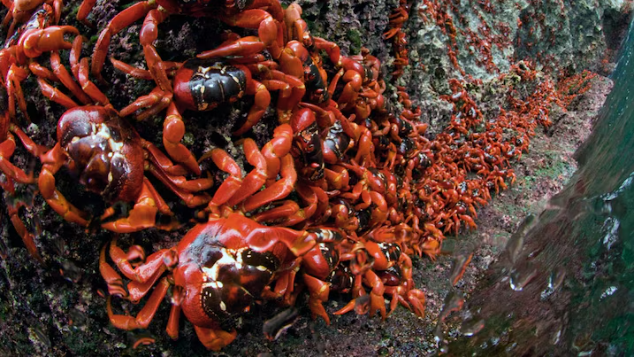
Christmas Island red crabs are famous throughout Australia and the world for their bright red color and for their spectacular annual migration to the sea.
Millions of crabs become rivers of red as they move from Christmas Island’s interior rainforests to the ocean to breed and lay eggs. During migration, red crabs climb over and around obstacles in their way, following the same migration paths every year.
Overview
The Christmas Island Red Crab (Gecarcoidea natalis) is one of the most famous and spectacular land crabs in the world. Native to Christmas Island, an Australian territory in the Indian Ocean, this bright-red crab is best known for its enormous annual migration from the island’s forests toward the coast to reproduce.
Millions of red crabs may take part in the migration, creating one of the most remarkable wildlife spectacles on Earth. Roads, bridges, and other areas of the island can become covered with moving red crabs as they travel toward the ocean.
Despite spending most of their adult lives on land, Christmas Island red crabs depend heavily on the sea for reproduction. Their life cycle is closely connected to the island’s tropical rainforest, seasonal rainfall, and surrounding ocean.
Scientific Classification
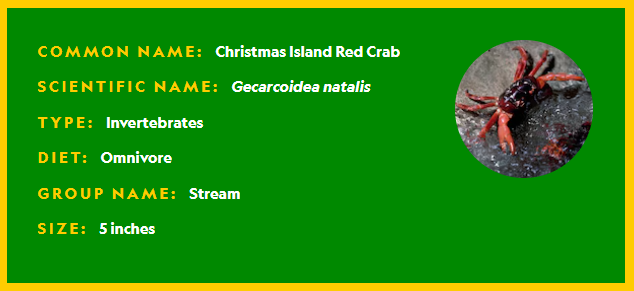
- Common name: Christmas Island Red Crab
- Scientific name: Gecarcoidea natalis
- Kingdom: Animalia
- Phylum: Arthropoda
- Class: Malacostraca
- Order: Decapoda
- Family: Gecarcinidae
- Genus: Gecarcoidea
- Species: Gecarcoidea natalis
- Type: Land crab
- Distribution: Christmas Island, Indian Ocean
- Habitat: Tropical rainforest and coastal areas
- Diet: Omnivorous, with a strong preference for plant material and organic matter
What Does a Christmas Island Red Crab Look Like?
The Christmas Island red crab is immediately recognizable because of its brilliant red coloration. Adult crabs generally have a broad, rounded body protected by a hard shell called a carapace.
Their coloration can vary somewhat from bright scarlet to deeper orange-red or dark red. The legs and claws are also typically reddish.
Main physical features include:
- Bright red or orange-red body
- Hard protective carapace
- Ten legs, including two claw-bearing front appendages
- Long walking legs adapted for movement on land
- Small eyes positioned on movable stalks
- Powerful claws used for feeding and handling food
- Hard exoskeleton that protects the body
- Flattened body adapted to moving through leaf litter and forest environments
Like other crustaceans, the red crab must periodically shed its old exoskeleton to grow. This process is called molting.
Size
Adult Christmas Island red crabs are relatively large compared with many other terrestrial crabs.
An adult may reach approximately 11–12 centimeters (4.3–4.7 inches) across the carapace, although individual size varies.
Males are generally larger than females, and their claws can also be more prominent.
Where Does the Christmas Island Red Crab Live?
The species is native primarily to Christmas Island, located in the eastern Indian Ocean, northwest of Australia.
The island provides an ideal environment because it contains extensive tropical rainforest, steep terrain, limestone caves, and coastal areas.
Red crabs spend much of their lives inland, particularly in moist forest environments. They may live considerable distances from the coast during much of the year.
Although they are land-dwelling animals, the ocean is essential to their reproductive cycle.
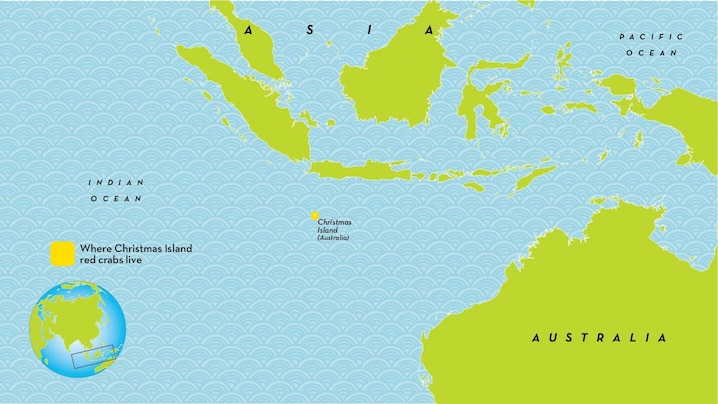
Christmas Island red crabs live on Christmas Island in the Indian Ocean off Australia’s northern coast, about 240 miles (380 kilometers) south of Java, Indonesia. Red crabs must keep their bodies moist, so they wait for the rainy season to provide conditions that are ideal for the difficult journey. A single female can lay up to 100,000 eggs.
Importance to Christmas Island
The red crab is much more than an ordinary animal on Christmas Island.
It is one of the island’s most recognizable species and plays an important role in its ecosystem.
The crab:
- Moves nutrients through the forest
- Consumes fallen vegetation
- Influences forest-floor ecology
- Provides food for other animals
- Connects terrestrial and marine ecosystems through its life cycle
- Helps shape the island’s unique rainforest environment
Importance to the Ecosystem
The Christmas Island red crab is considered an important ecosystem engineer.
Because enormous numbers of crabs move through the forest and consume vegetation, they can influence the structure and functioning of the rainforest floor.
Their activities affect:
- Leaf-litter decomposition
- Nutrient cycling
- Soil disturbance
- Seedling growth
- Forest-floor vegetation
- Organic matter distribution
Their migration also creates a remarkable ecological connection between the island’s rainforest and the surrounding ocean.
Adaptations to Life on Land
Although descended from marine ancestors, Christmas Island red crabs have evolved many adaptations for terrestrial life.
These include:
- Strong walking legs
- Ability to breathe atmospheric oxygen using modified gill structures
- Behavior that reduces water loss
- Use of humid forest environments
- Burrowing behavior
- Ability to travel considerable distances across land
- Seasonal migration linked to rainfall
However, they still require access to water and humid conditions, especially during reproduction and early development.
Why Are They Red?
The species gets its common name from its characteristic red coloration.
The exact intensity of the color can vary among individuals, but the brilliant red appearance makes large groups of migrating crabs particularly spectacular.
The color also makes them easy to recognize against the green rainforest.
Communication
Christmas Island red crabs do not communicate using complex vocal systems like birds or mammals.
Instead, much of their interaction occurs through physical signals, chemical cues, posture, and movement.
During reproduction and competition, body position and claw displays may help communicate aggression or dominance.
Chemical cues may also help individuals recognize environmental conditions and other crabs.
