

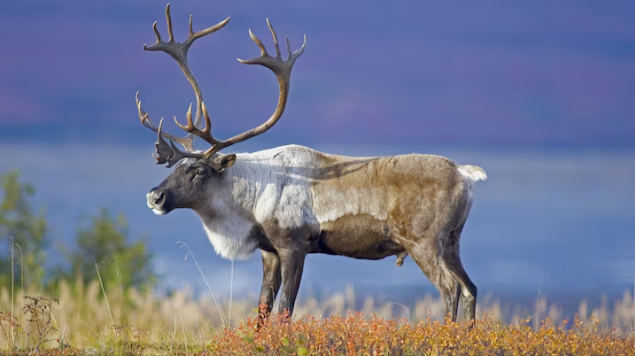
Caribou are mammals that live in the northern regions of Europe, North America, Asia, and Greenland. When snow begins to fall, caribou move south and travel to more sheltered climes where they can feed on moss or lichens.
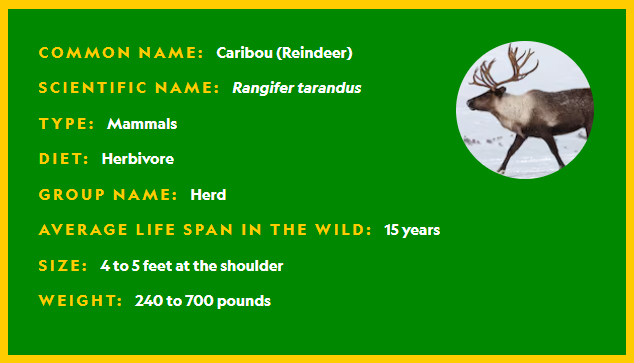
These members of the deer family dig for food using their large hooves. The underside of each hoof is hollowed out like a big scoop and allows the caribou to dig through snow in search of food.
Caribou trek north in the summer in one of the largest animal migrations on Earth. They travel more than 600 miles (965 kilometers) along well-traveled routes. They spend the summer feeding on grasses, mushrooms, and plants in the tundra. They begin to move south in the winter and over one year they will have migrated over 1,600 miles (2,574 kilometers). One adult caribou eats about 12 pounds (5 kilograms) of food each day. Caribou are hunted by Indigenous northern people throughout much of their range. Woodland caribou are listed as endangered, but other caribou populations are stable.
Introduction
The caribou is one of the most remarkable large mammals of the northern world. Known for its enormous seasonal migrations, impressive antlers, thick coat, and extraordinary ability to survive in freezing Arctic and subarctic environments, the caribou is an essential part of northern ecosystems.
In North America, the animal is commonly called caribou, while the same species is generally known as the reindeer in Europe and Asia. Its scientific name is Rangifer tarandus.
Unlike most members of the deer family, both male and female caribou grow antlers. Caribou are also famous for traveling in large herds and undertaking some of the longest terrestrial migrations performed by mammals.
They are specially adapted to environments where temperatures can fall dramatically below freezing and where food can be buried beneath snow for much of the year.
Caribou are important not only ecologically but also culturally and historically. Indigenous peoples of the Arctic and subarctic have relied on caribou for food, clothing, tools, transportation, and cultural traditions for thousands of years.
Quick Facts About Caribou
- Common name: Caribou
- Also called: Reindeer
- Scientific name: Rangifer tarandus
- Family: Cervidae
- Order: Artiodactyla
- Class: Mammalia
- Diet: Herbivore
- Average lifespan: Approximately 10–15 years in the wild
- Potential lifespan: Some individuals can live longer
- Adult weight: Approximately 60–180 kg (132–397 lb), depending on sex and population
- Shoulder height: Approximately 80–150 cm (31–59 in)
- Body length: Approximately 120–220 cm (47–87 in)
- Habitat: Arctic tundra, boreal forest, mountains, wetlands, and subarctic landscapes
- Geographic range: Northern North America, Greenland, northern Europe, and northern Asia
- Activity: Active throughout the year
- Diet: Lichens, grasses, sedges, leaves, shrubs, mushrooms, and other vegetation
- Special adaptation: Both males and females grow antlers
- Major predators: Wolves, bears, wolverines, lynx, and humans
- Conservation: Varies greatly among populations
- Most famous behavior: Long-distance seasonal migration
What Is a Caribou?
A caribou is a large member of the deer family adapted to cold northern environments.
The species Rangifer tarandus includes several geographically and ecologically distinct populations and forms.
In North America, the word caribou is commonly used.
In Europe and Asia, the animal is generally called a reindeer.
Despite the different names, they are members of the same species.
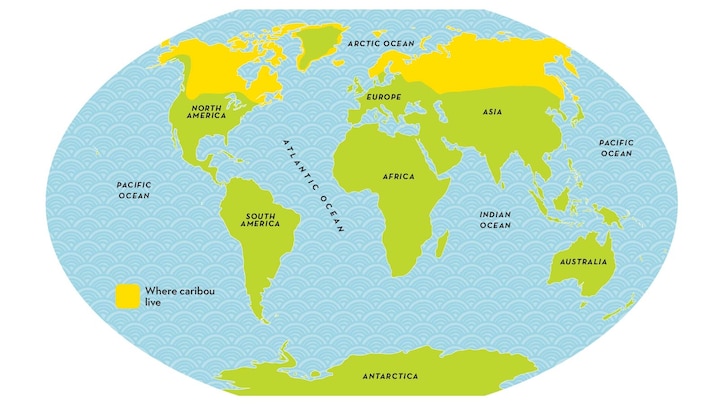
National Geographic Maps
Where Do Caribou Live?
Caribou inhabit some of the coldest environments on Earth.
Their range extends across parts of:
- Canada
- Alaska
- Greenland
- Norway
- Sweden
- Finland
- Russia
Historically, caribou and reindeer had a broader distribution than they do today.
Different populations are adapted to different environments, from Arctic tundra to boreal forests.
Caribou Habitat
Caribou can live in several northern habitats.
Arctic Tundra
During the warmer months, many caribou travel onto tundra landscapes where fresh vegetation becomes available.
The tundra provides:
- Grasses
- Sedges
- Shrubs
- Flowers
- Lichens
- Other seasonal vegetation
Boreal Forest
Some populations spend substantial portions of the year in northern forests.
Forested environments provide shelter from:
- Extreme cold
- Wind
- Snow
- Predators
Mountains
Mountain caribou populations may use alpine valleys, slopes, and forested mountain landscapes.
Wetlands
Wetlands can provide rich seasonal vegetation and areas where caribou can escape insects.
Caribou Distribution
Caribou populations are not evenly distributed.
Some populations occupy enormous territories, while others are much smaller and more isolated.
Their distribution depends on:
- Food availability
- Snow conditions
- Predator populations
- Climate
- Human development
- Migration routes
- Habitat quality
Caribou Body Shape
Caribou have a distinctive body shape that helps them survive in cold environments.
They have:
- Long legs
- Strong shoulders
- Large hooves
- Thick fur
- Compact bodies
- Powerful muscles
Their bodies are built for traveling long distances across snow, ice, tundra, forests, and rugged terrain.
