

By Allyson Shaw
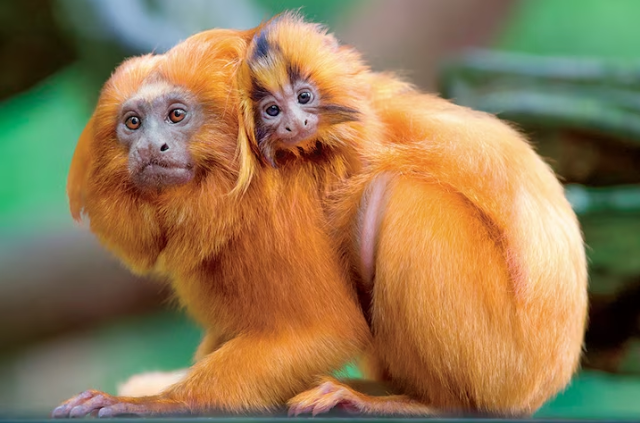
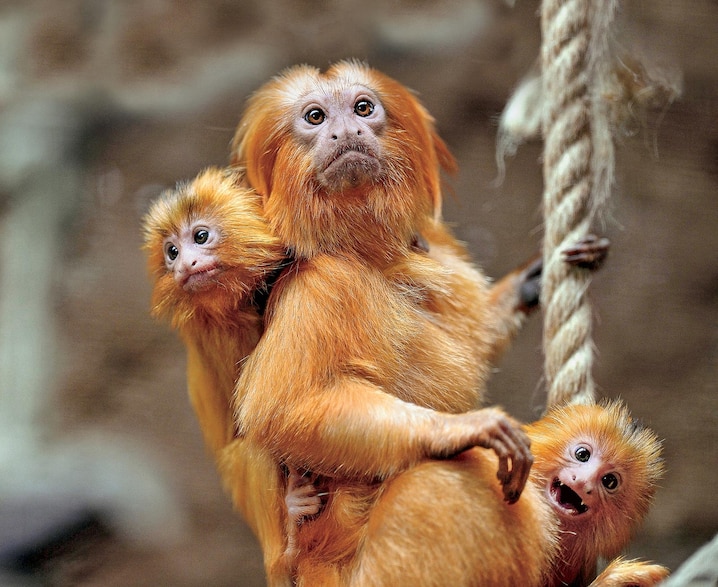
A family of golden lion tamarins is on the move. With two babies on his back and his mate beside him, the father tamarin reaches for a branch in Brazil’s Atlantic Forest. Just a few years ago, this land was a treeless cattle pasture. But conservationists knew that if more forest was lost, then the golden lion tamarins—which live wild nowhere else on Earth—would be gone too.
Introduction
The golden lion tamarin (Leontopithecus rosalia) is a small, brilliantly colored primate native to the Atlantic Forest of southeastern Brazil. Famous for its glowing orange-gold fur and dramatic mane surrounding its face, this endangered monkey is one of Brazil’s most recognizable animals.
Despite its small size, the golden lion tamarin plays an important role in its forest ecosystem. It lives mainly in the treetops, travels through branches with remarkable agility, searches for insects and fruit, and helps disperse seeds throughout the forest.
The species has faced severe habitat loss and population decline, but conservation programs have achieved important successes. Habitat protection, reforestation, wildlife corridors, scientific research, and carefully managed reintroduction programs have helped bring golden lion tamarins back from the brink of extinction.
- Scientific Classification
- Common name: Golden lion tamarin
- Scientific name: Leontopithecus rosalia
- Kingdom: Animalia
- Phylum: Chordata
- Class: Mammalia
- Order: Primates
- Family: Callitrichidae
- Genus: Leontopithecus
- Species: Leontopithecus rosalia
- Type: New World monkey
- Diet: Omnivorous
- Activity: Primarily diurnal
- Habitat: Tropical Atlantic Forest
- Native country: Brazil
- Conservation status: Endangered
Golden Lion Tamarin Size
Golden lion tamarins are among the smallest monkeys in the world.
Typical adults weigh approximately:
- Body weight: Around 500–700 grams
- Body length: Approximately 20–34 centimeters
- Tail length: Approximately 30–40 centimeters
The tail is generally longer than the body.
Their small size allows them to move efficiently through the dense branches and vines of the Atlantic Forest.
Disappearing forests
The Atlantic Forest was once about the size of Egypt. But in the 1500s, Europeans started cutting trees to build ships and make room for settlements—and the forest clearing didn’t stop. Over the past century, farmers cut down more trees to make way for sugarcane, coffee, and cattle farms until the forest was less than 10 percent of its original size.
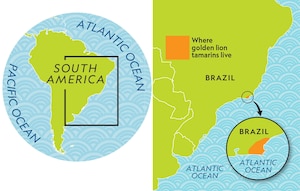
Where golden lion tamarins live
Map by MARTIN WALZ
Golden lion tamarins spend most of their time in the tree canopy, using branches to travel in search of food and mates. As the forest shrunk, habitats became cut off from each other—and so did the primates. By the 1970s, concerned biologists estimated that only about 200 golden lion tamarins were left in the Atlantic Forest.
Monkey boot camp
Conservationists gathered at the Smithsonian Institution’s National Zoo in Washington, D.C., in 1972 to develop a plan to save the species in the wild. Some zoos already had golden lion tamarins in captivity; all they had to do was breed more tamarins, then prepare some of the families to return to the wild. How? “We sent them to boot camp,” says Kenton Kerns, assistant curator of small mammals at the National Zoo.
