

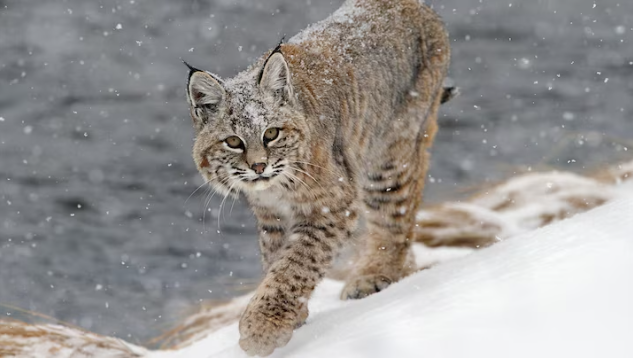
A hungry bobcat crouches behind a bush, looking at the field beyond its leafy hideaway. Suddenly, a squirrel darts across the ground. As the squirrel draws near, the cat leaps from the bush and scoops up the prey in its mouth. It’s dinnertime.
By Meghan Modafferi
Bobcat versus house cat
Bobcats may look cute and cuddly, but these felines that live throughout North America are actually fierce predators. They can leap as far as 12 feet to catch prey and have been known to take down much larger animals, such as young deer.
The wild feline is about twice as big as a house cat—and a lot faster. It can run at speeds up to 25 to 30 miles an hour, and it’s skilled at swimming. But the wild cat isn’t totally different from a domestic kitty. Both use whiskers like fingertips to help them feel around their habitat and judge whether an opening is big enough to fit through. They’re both also night owls with superb night vision that helps them see in the dark.
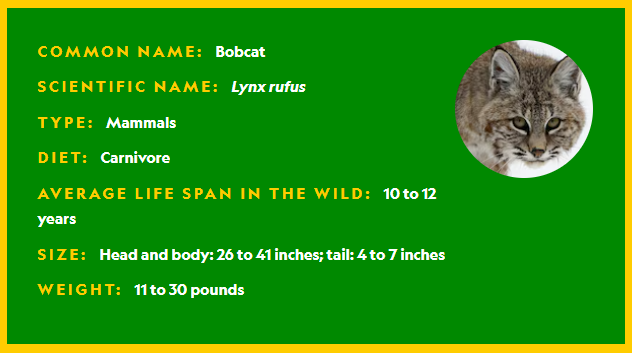
Quick Facts About Bobcats
- Common name: Bobcat
- Scientific name: Lynx rufus
- Animal family: Felidae
- Order: Carnivora
- Class: Mammalia
- Genus: Lynx
- Average lifespan in the wild: Around 7–10 years, although some individuals live longer
- Maximum recorded lifespan: More than 15 years in some cases
- Typical adult weight: Approximately 13–30 pounds (6–14 kg)
- Length: Approximately 25–40 inches (64–102 cm), excluding the tail
- Tail length: Approximately 4–7 inches (10–18 cm)
- Shoulder height: Approximately 18–24 inches (46–61 cm)
- Diet: Carnivore
- Activity: Mostly crepuscular and nocturnal
- Habitat: Forests, mountains, deserts, grasslands, wetlands, shrublands, and suburban areas
- Geographic range: Much of the United States, southern Canada, and parts of Mexico
- Conservation status: Least Concern
- Main hunting strategy: Stalking, ambushing, and pouncing
- Distinctive feature: Short tail with a black-tipped end
The bobcat is one type of lynx. The others are Canada lynx, Iberian lynx, and Eurasian lynx.
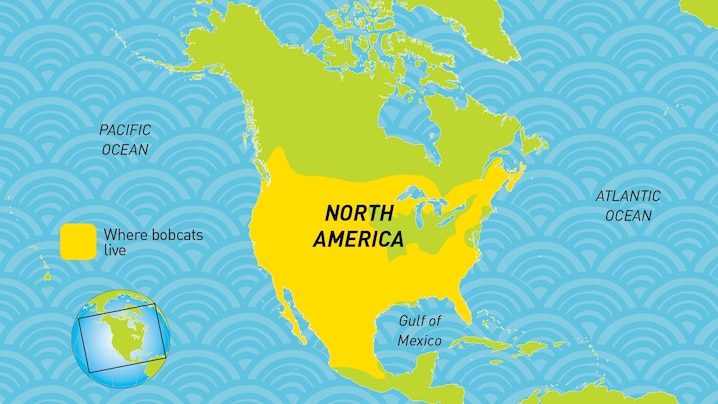
Bobcat Habitat
Bobcats are highly adaptable because they do not depend on one specific habitat type.
A suitable bobcat habitat generally provides:
- Food
- Water
- Vegetation or natural cover
- Places to rest
- Areas for raising kittens
- Opportunities to hunt
- Safe travel routes
Dense vegetation and natural cover are especially important because bobcats are ambush predators.
What Do Bobcats Eat?
Bobcats are strict carnivores, meaning their diet consists primarily of animal prey.
Their most important food sources often include:
- Rabbits
- Hares
- Mice
- Rats
- Squirrels
- Chipmunks
- Birds
- Ground-nesting birds
- Reptiles
- Amphibians
- Fish
- Insects
- Other small mammals
They can occasionally kill larger prey when an opportunity arises.
In some areas, bobcats may prey on animals such as:
- Raccoons
- Opossums
- Young deer
- Domestic animals
- Larger birds
The exact diet varies according to location and seasonal availability.
Bobcat Subspecies
The bobcat is a highly variable species with different populations showing differences in body size, fur color, and markings.
Historically, scientists have recognized numerous subspecies or geographic forms of Lynx rufus. Modern genetic research has changed how scientists understand some of these populations, so classifications can vary between sources.
Regional bobcats may look different depending on climate and habitat.
Northern individuals may have thicker, longer coats, while bobcats living in warmer environments can have shorter, lighter-colored fur.
