

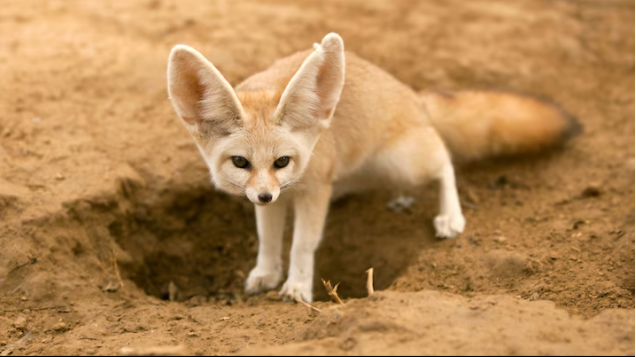
Smallest Fox
Introduction
The fennec fox (Vulpes zerda) is a tiny desert fox famous for its enormous ears, delicate appearance, and remarkable ability to survive in one of the hottest and driest environments on Earth. Native to the deserts of North Africa, this small nocturnal mammal has evolved a fascinating collection of adaptations that help it cope with extreme heat, limited water, blowing sand, and cold desert nights.
Although the fennec fox is the smallest member of the fox family, its oversized ears make it instantly recognizable. These ears are not simply a distinctive feature—they play an important role in helping the fox locate prey and release excess body heat.
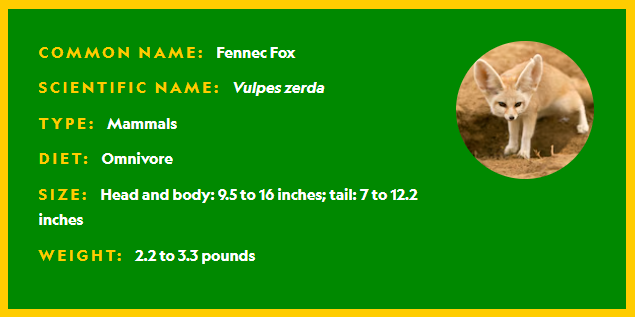
Fennec foxes are sometimes called “desert foxes” because they live in desert zones of North Africa and the Sinai and Arabian peninsulas. They are nocturnal and avoid the daytime heat of the desert environment. Their batlike ears radiate body heat and help keep the foxes cool. They also have long, thick, soft fur coats with a wooly undercoat that insulates them during cold nights and protects them from the hot sun during the day.
They have been known to jump in the air 2 feet (.6 meters) high from a standing position, and they are able to leap a distance of 4 feet (1.2 meters).
These foxes dwell in small groups of up to ten individuals. Like dogs and other canids, male fennecs mark their territory with urine.
Scientific Classification
Common Name: American Bison
Scientific Name: Bison bison
Kingdom: Animalia
Phylum: Chordata
Class: Mammalia
Order: Artiodactyla
Family: Bovidae
Genus: Bison
Species: Bison bison
The American bison is a member of the Bovidae family, which includes cattle, sheep, goats, antelope, and other hoofed mammals.
There are two commonly recognized subspecies of American bison:
- Plains bison (Bison bison bison) – primarily associated with the Great Plains and grassland regions.
- Wood bison (Bison bison athabascae) – generally larger and associated with the forests and northern regions of Canada.
What Does an American Bison Look Like?
The American bison has an extremely powerful and distinctive body shape.
Its most noticeable feature is its enormous shoulder hump, created by large muscles and vertebrae that support its massive head and neck. The front portion of the body is much heavier and more muscular than the rear.
Adult bison typically have:
- A large, heavy head
- Short, curved black horns
- A prominent shoulder hump
- Thick neck and powerful shoulders
- Long, shaggy hair around the head and forequarters
- A shorter, smoother coat toward the rear
- A short tail ending in a tuft of hair
- Strong legs and cloven hooves
- A dark brown to nearly black-brown coat
Their thick winter coat provides excellent insulation against freezing temperatures, snow, and strong winds.
During warmer months, bison shed much of their heavy winter fur. They may appear noticeably slimmer and less shaggy during summer.

Check out where fennec foxes live.
National Geographic Maps
bison.
Where Do American Bison Live?
Historically, American bison occupied an enormous portion of North America.
Their historic range extended across much of:
- Canada
- The United States
- The Great Plains
- The Rocky Mountain region
- Prairie ecosystems
- Grasslands
- Open woodlands
- River valleys
Today, wild and conservation herds are found in a much smaller portion of their former range.
Important populations occur in places such as:
- Yellowstone National Park
- Grand Teton region
- Theodore Roosevelt National Park
- Badlands National Park
- Wind Cave National Park
- Custer State Park
- Wood Buffalo National Park
- Other protected areas and conservation lands
Some bison also live on lands managed by Native American tribes and Indigenous communities.
Habitat
American bison are strongly associated with grassland ecosystems, although they can survive in a variety of environments.
Their habitats can include:
- Prairies
- Plains
- Grasslands
- Meadows
- River valleys
- Open forests
- Sagebrush country
- Mountain valleys
- Northern woodland environments
Bison are remarkably adaptable. They can survive intense heat, deep snow, freezing temperatures, drought, and seasonal changes.
Their ability to find food beneath snow and travel through difficult winter conditions allows them to remain in northern habitats throughout the year.
Single
Enrich our growing community.
- General admission and member discounts for one adult
- One free ticket per special exhibition
- Two single-use guest passes per year
Family
Support special exhibitions.
- General admission and member discounts for two adults
- Four free tickets per special exhibition
- Four single-use guest passes per year
Patron
Take support to the next level.
- General admission and member discounts for two adults
- Five free tickets per special exhibition
- Six single-use guest passes per year
