

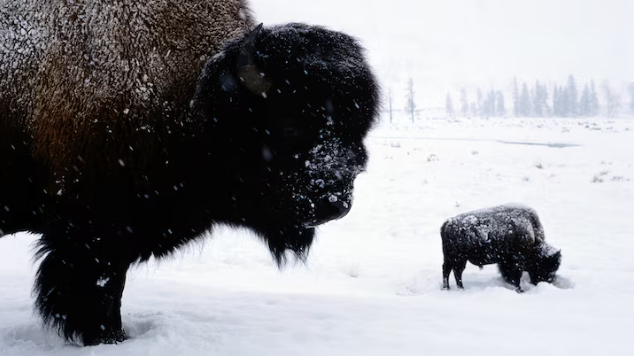
Bison are the iconic image of the Great Plains and the Old West. They are massive, shaggy beasts and the heaviest land animals in North America.
The American bison (Bison bison) is one of North America’s most iconic and recognizable mammals. Often mistakenly called a “buffalo,” the American bison is actually a bison species and is more closely related to the European bison than to true buffalo such as the African buffalo or water buffalo.
With its massive shoulders, large head, curved horns, shaggy brown coat, and distinctive hump, the American bison is perfectly adapted to life on the open grasslands and prairies of North America.
Once numbering in the tens of millions, American bison once roamed across enormous areas of the continent. Their dramatic population decline during the 19th century became one of the most important wildlife conservation stories in North American history. Today, conservation programs, protected lands, national parks, tribal nations, ranches, and wildlife organizations are helping maintain and restore bison populations.
Scientific Classification
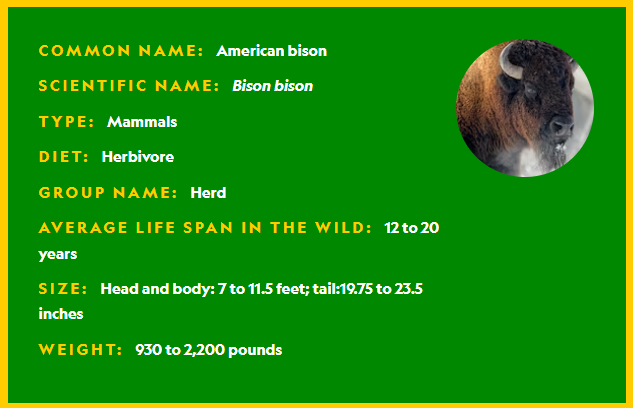
Common Name: American Bison
Scientific Name: Bison bison
Kingdom: Animalia
Phylum: Chordata
Class: Mammalia
Order: Artiodactyla
Family: Bovidae
Genus: Bison
Species: Bison bison
The American bison is a member of the Bovidae family, which includes cattle, sheep, goats, antelope, and other hoofed mammals.
There are two commonly recognized subspecies of American bison:
- Plains bison (Bison bison bison) – primarily associated with the Great Plains and grassland regions.
- Wood bison (Bison bison athabascae) – generally larger and associated with the forests and northern regions of Canada.
What Does an American Bison Look Like?
The American bison has an extremely powerful and distinctive body shape.
Its most noticeable feature is its enormous shoulder hump, created by large muscles and vertebrae that support its massive head and neck. The front portion of the body is much heavier and more muscular than the rear.
Adult bison typically have:
- A large, heavy head
- Short, curved black horns
- A prominent shoulder hump
- Thick neck and powerful shoulders
- Long, shaggy hair around the head and forequarters
- A shorter, smoother coat toward the rear
- A short tail ending in a tuft of hair
- Strong legs and cloven hooves
- A dark brown to nearly black-brown coat
Their thick winter coat provides excellent insulation against freezing temperatures, snow, and strong winds.
During warmer months, bison shed much of their heavy winter fur. They may appear noticeably slimmer and less shaggy during summer.
Size and Weight
American bison are among the largest land mammals in North America.
Males
Adult males, known as bulls, are generally larger and heavier than females.
Typical adult bulls can weigh approximately 1,000–2,000 pounds (450–900 kg), although exceptionally large individuals can exceed these figures.
They can stand roughly 5–6 feet (1.5–1.8 meters) tall at the shoulder.
Females
Adult females, known as cows, are generally smaller.
They commonly weigh approximately 700–1,200 pounds (320–550 kg).
Despite being smaller than bulls, female bison are still extremely powerful animals.
Calves
Newborn bison calves are much smaller than adults and are usually born with a reddish or reddish-brown coat. Their coloring gives rise to the nickname “red dogs.”
As they grow, their coat gradually becomes darker and develops the characteristic appearance of an adult bison.
Where Do American Bison Live?
Historically, American bison occupied an enormous portion of North America.
Their historic range extended across much of:
- Canada
- The United States
- The Great Plains
- The Rocky Mountain region
- Prairie ecosystems
- Grasslands
- Open woodlands
- River valleys
Today, wild and conservation herds are found in a much smaller portion of their former range.
Important populations occur in places such as:
- Yellowstone National Park
- Grand Teton region
- Theodore Roosevelt National Park
- Badlands National Park
- Wind Cave National Park
- Custer State Park
- Wood Buffalo National Park
- Other protected areas and conservation lands
Some bison also live on lands managed by Native American tribes and Indigenous communities.
Despite their hefty size, bison are quick on their feet. When the need arises they can run at speeds up to 35 miles an hour. Their curved, sharp horns can grow to be 2 feet long.
Females (cows) and adult males (bulls) generally live in small, separate bands and come together in very large herds during the summer breeding season. Males wage battles for mating rights, but such contests rarely turn dangerous. Females give birth to one calf after a nine-month pregnancy.

Bison once covered the Great Plains and much of North America, and were critically important to Plains Indian societies. During the 19th century, settlers killed some 50 million bison for food, sport, and to deprive Native Americans of their most important natural asset. The once enormous herds were reduced to only a few hundred animals. Today, bison numbers have rebounded somewhat, and about 200,000 bison live on preserves and ranches where they are raised for their meat.
01:16
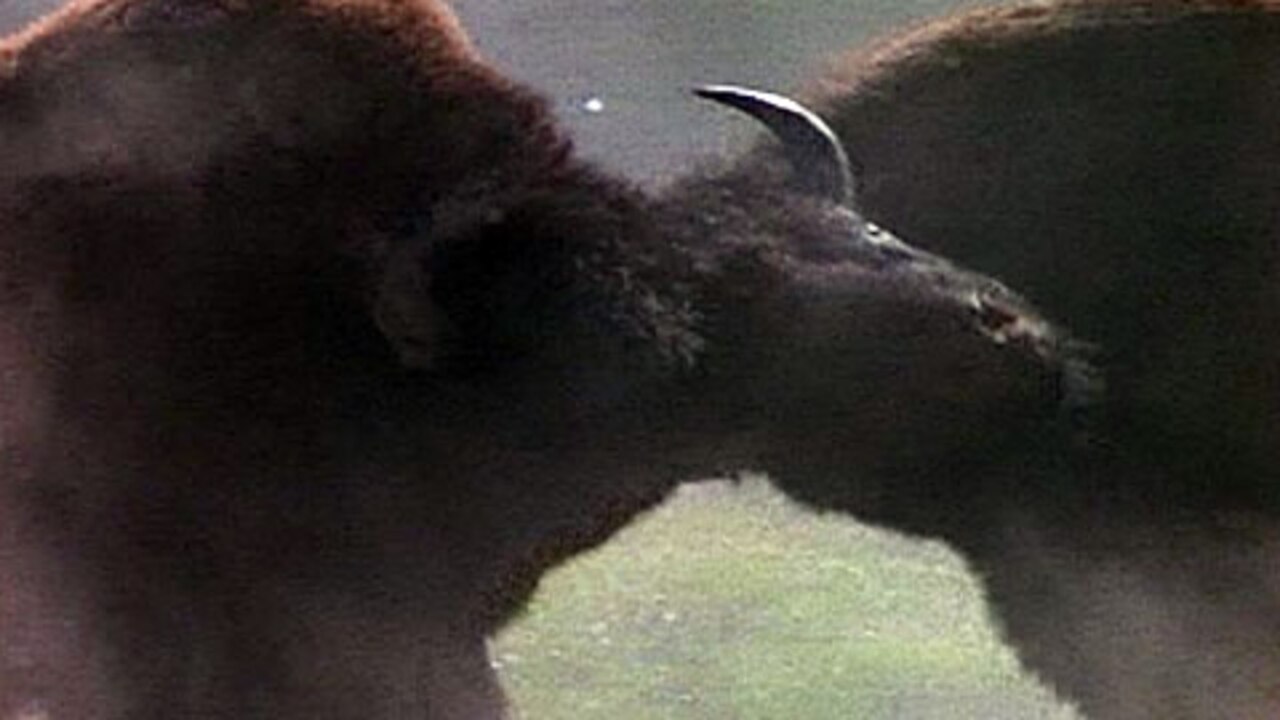
Bison Headbutting
Prepare yourself for the battle of the bulls in Yellowstone, when male bison battle head-to-head for a chance to mate with females.
Habitat
American bison are strongly associated with grassland ecosystems, although they can survive in a variety of environments.
Their habitats can include:
- Prairies
- Plains
- Grasslands
- Meadows
- River valleys
- Open forests
- Sagebrush country
- Mountain valleys
- Northern woodland environments
Bison are remarkably adaptable. They can survive intense heat, deep snow, freezing temperatures, drought, and seasonal changes.
Their ability to find food beneath snow and travel through difficult winter conditions allows them to remain in northern habitats throughout the year.
Diet
American bison are herbivores, meaning they eat plants.
Grass makes up the majority of their diet.
Depending on their habitat and season, bison may consume:
- Grasses
- Sedges
- Herbs
- Leaves
- Shoots
- Other available vegetation
Bison spend a significant portion of their day feeding.
Their digestive system is adapted for processing large quantities of fibrous plant material. Like cattle and other ruminants, they have a specialized multi-chambered stomach that allows them to digest tough vegetation efficiently.
After eating, bison often rest and regurgitate partially digested food, which they chew again in a process called rumination.
How American Bison Feed
Bison use their large heads and powerful neck muscles to reach vegetation.
During winter, they can use their massive heads to push or sweep snow away from the ground to reach grasses underneath.
This behavior is sometimes called snowplowing.
Their grazing can have an important ecological effect. By eating grasses and disturbing vegetation, bison influence plant growth and help create a constantly changing landscape that benefits many other species.
Speed
An American bison may look slow because of its enormous body, but it can move surprisingly fast.
A bison can reach speeds of approximately 35 miles per hour (55 km/h) over short distances.
They can also turn quickly and are capable of jumping over obstacles.
This combination of size, speed, strength, and agility makes bison potentially dangerous when approached too closely.
Wild bison should always be observed from a safe distance.
Communication
Bison communicate using a variety of sounds, movements, and body signals.
They may:
- Grunt
- Snort
- Bellow
- Growl
- Make other low-frequency vocalizations
Body language is also extremely important.
A bison may communicate agitation or aggression by:
- Lowering its head
- Pawing the ground
- Snorting
- Raising its tail
- Shaking its head
- Displaying its horns
- Charging
These behaviors are warnings that should never be ignored.
